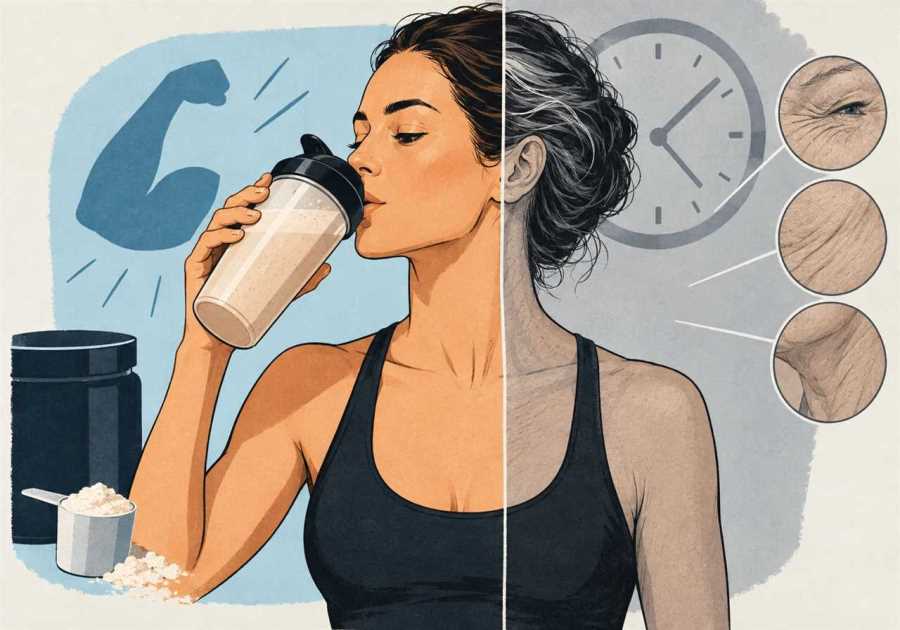
I've been seeing protein everywhere lately. Protein yogurt, protein cereal bars, protein water, for crying out loud. Every influencer on my feed is telling me to chug another shake if I want to stay strong past 60.
So naturally, I got curious. Is more really better? Or have we just been sold a really convincing story?
Turns out, the science is more complicated than the marketing.
The Study That's Stirring Things Up
A team at the University of Wisconsin-Madison just dug through more than 350 scientific studies looking at how protein connects to metabolism and aging. Their findings, published in Cell Press Blue, point to something researchers didn't expect: eating a bit less protein might actually support healthy aging better than loading up on it.
That doesn't mean toss the protein powder in the trash. Age, activity level, and overall health all factor into how much protein your body actually needs. But it does mean the "more is always better" crowd might want to slow down.
A Hormone Called FGF21
Here's where it gets interesting. The researchers zeroed in on a hormone called FGF21. When your protein intake drops, your body produces more of it. And FGF21 seems to do some good things—it may help burn energy more efficiently, keep blood sugar steadier, and lower inflammation.
In mice, higher FGF21 levels are linked to longer lifespans. We don't have proof yet that the same holds true for humans. But the pattern is enough to make scientists pay attention.
It's Not Just How Much—It's What Kind
When you eat protein, your body breaks it down into amino acids, which it uses to repair and build muscle. Makes sense. But certain amino acids—methionine, isoleucine, and valine—can push your cells to grow and multiply when you eat too much of them.
That's great if you just finished a hard workout and your body needs to rebuild. But if you're sitting at a desk all day eating protein bars "just in case," those same amino acids might contribute to inflammation, weight gain, and age-related disease.
There's a study in Nutrients that backs this up. People with metabolic syndrome—extra belly fat, high blood sugar, high blood pressure—cut back on protein and saw real improvements: less fat, better blood sugar. The trial was too short to know if it extends life, but the early results are hard to ignore.
So Should You Cut Protein Out?
No. Don't do that.
Protein is still essential—for muscles, bones, organs, the whole operation. Athletes, pregnant women, people recovering from illness, and a lot of older adults actually need more of it, not less.
Here's the twist that makes this whole thing so interesting: a study in Cell Metabolism found that low protein intake was linked to lower mortality before age 65—but not after. Past 65, protein looks protective instead of risky.
I'm closing in on 70 myself, and that detail matters to me. It's not about less protein across the board. It's about matching your protein to where you actually are in life.
Quality Over Quantity
Here's another piece worth knowing. A massive study of more than 400,000 people, published in JAMA Internal Medicine, found that people who ate more plant-based protein had a slightly lower risk of death compared to those loading up on animal protein.
So maybe the answer isn't "eat less protein." Maybe it's "trade some of that steak for lentils, chickpeas, beans, and nuts."
What This Means for You
None of this proves that less protein slows aging in humans. We're not there yet. But it's a nudge to stop reaching for protein-fortified everything out of habit, especially if you're not that active.
The real question worth asking yourself: does your protein intake match your actual life? Are you training hard, recovering from something, or pushing 70 and trying to hang onto muscle? Or are you just following a trend because the package said "high protein" in bold letters?
I've learned that the best health decisions come from asking "what does my body actually need right now?" instead of copying whatever's trending. Getting that balance right might be the real secret to aging well—no shake required.
Source: Futura, le média qui explore le monde
Before this, we covered: Want a Sharper Mind in Your 70s? Join a Club. Or Three.