I've been popping taurine in my energy drinks for years without ever asking what it actually does. Turns out, it might be doing a lot more than keeping me awake on long drives.
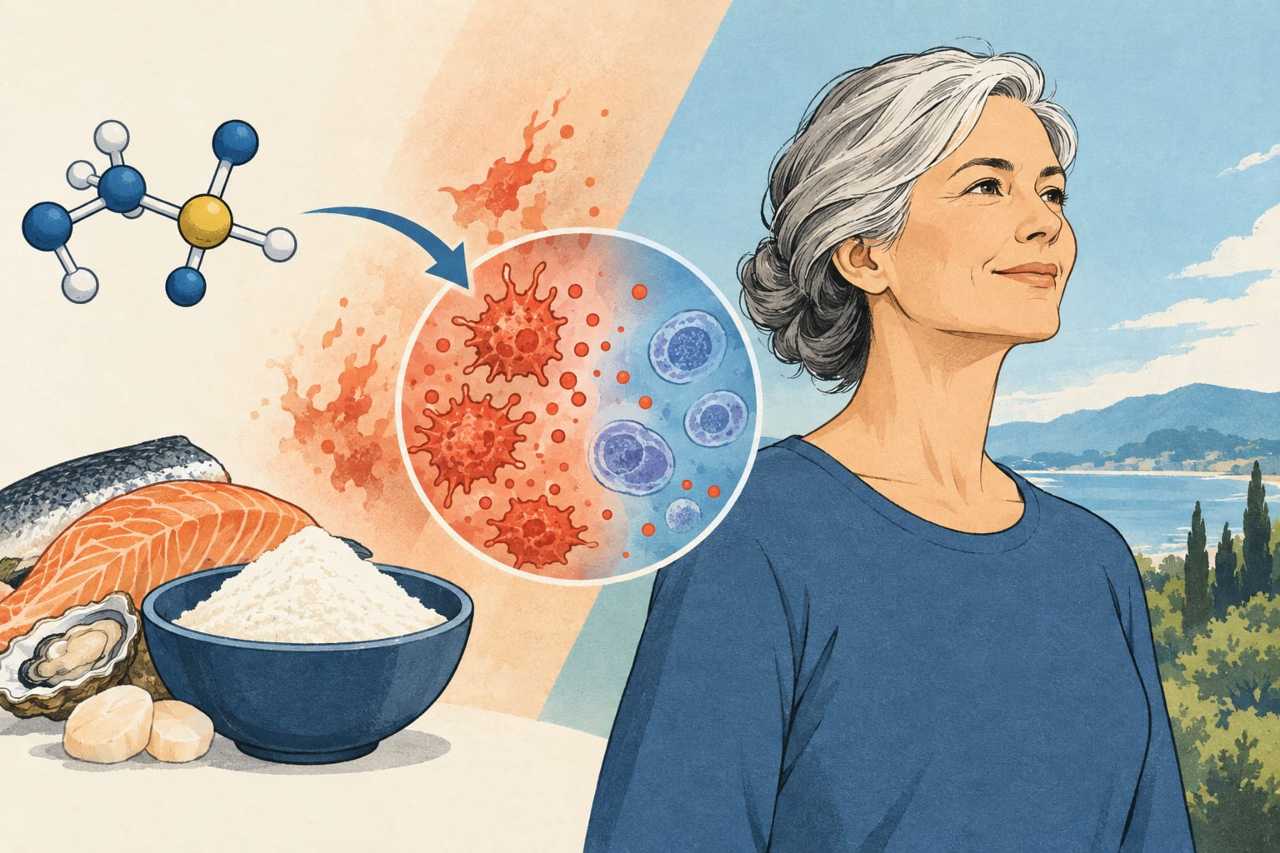
A new study out of Yale is looking at taurine and its role in something researchers call "inflammaging." That's the low-grade, chronic inflammation that creeps up as we get older and quietly contributes to just about every age-related disease you can name. Heart disease. Diabetes. Alzheimer's. Arthritis. The list goes on.
And according to this research, taurine helps regulate that inflammation.
What's taurine anyway?
Taurine is an amino acid your body makes naturally. It's also in meat, fish, and dairy, and yes, in those energy drinks with the bull on the can. For a long time it was treated as a bit of a footnote in nutrition science. Not essential, not dangerous, just there.
That reputation has been shifting fast. A few years back, a widely discussed study found that taurine levels drop significantly as we age, in mice, monkeys, and humans. Researchers started wondering if that decline was a cause of aging, or just a side effect of it.
This Yale study pushes that question further by zeroing in on inflammation specifically. The idea is that taurine isn't just a passive bystander in your cells. It appears to actively help regulate the inflammatory response, the same response that goes haywire as we get older and starts attacking tissue it's supposed to be protecting.
Why does that matter to you? Because inflammation is one of the few aging mechanisms that scientists broadly agree is controllable. You can't stop time. But you might be able to influence how your body responds to it.
I like this because it's testable
Here's what I find genuinely interesting about this line of research. It's not another vague wellness trend. It's not "eat this superfood and feel ten years younger." It's specific biology. Taurine levels drop, inflammation rises, and now there's a mechanism connecting the two. That's the kind of thing you can actually study, measure, and eventually test in real people with real outcomes.
I've always been the type to ask "what happens if…" instead of just accepting the official story. For years the official story on taurine was basically "meh, it's fine, don't worry about it." Now it looks like that story was incomplete.
That doesn't mean I'm going to start chugging energy drinks at 69 and calling it longevity medicine. Most of those drinks come loaded with sugar and caffeine that cancel out whatever benefit the taurine might offer. But it does make me curious about supplementation, about diet, about what else we've dismissed too quickly because it didn't fit a simple narrative.
Age as data, not destiny
I've spent the years since 2017 traveling full-time, and one thing I've learned on the road is that your body keeps giving you information if you're willing to listen to it. Energy levels. Recovery time. How you feel after a long flight versus how you felt doing the same trip a decade ago.
Research like this Yale study is a reminder that aging isn't one single switch flipping off. It's a bunch of smaller systems, like inflammation regulation, gradually losing efficiency. And if you can identify which systems are slipping, you have a shot at intervening.
That's the whole mindset behind Adventure Has No Age Limit. Getting older isn't a wall you hit. It's a set of variables you can study and sometimes adjust. Taurine might end up being one small lever in that system. Exercise is another. Sleep, diet, stress, curiosity itself, they're all part of the same picture.
Where this goes next
Don't expect taurine supplements to replace sunscreen and exercise anytime soon. This is early-stage research, and there's a long road between "regulates inflammation in a lab study" and "proven to help you age better."
But it's one more piece of evidence that the biology of aging is more flexible than we used to think. That's good news if, like me, you plan on staying curious, active, and a little stubborn about slowing down.
What else is hiding in plain sight, dismissed as "nothing special" until someone finally asks the right question?
Source: News-Medical
Earlier in this series: Forget "Lifespan." Ian Clark Says You Should Be Chasing "Quality Span"