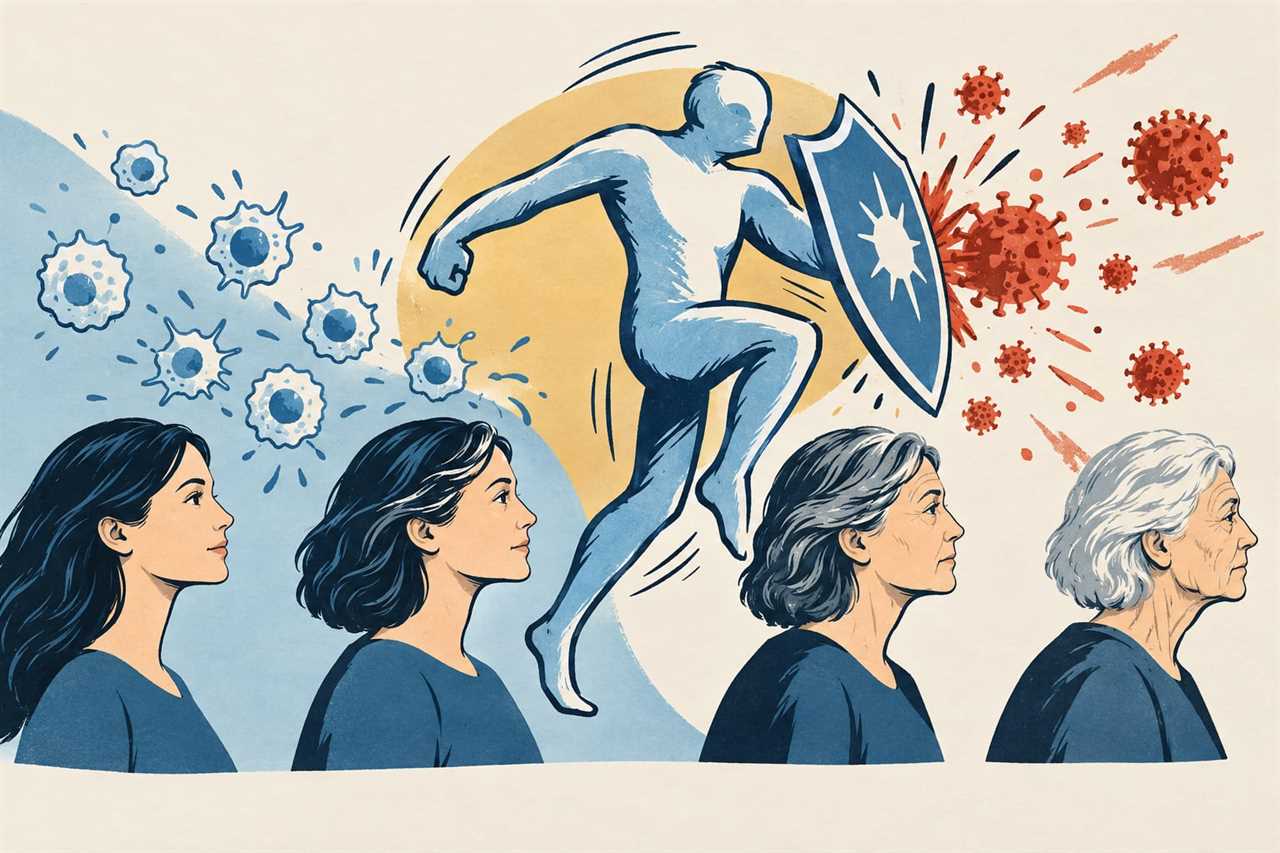
I've always assumed aging was a straight line. One candle at a time, one gray hair at a time, slow and steady decline. Turns out that's not how it works, at least not for your immune system.
Researchers at Duke-NUS Medical School just published a study that maps out something pretty wild: your immune cells don't age at a steady pace at all. They coast along for years, then hit sudden bursts of rapid change. Two of them, to be exact. One hits around age 40. The other shows up after 60.
Why does that matter? Because it might finally explain one of the strangest puzzles in medicine: women live longer than men, on average, but they get hit harder by autoimmune diseases. Lupus. Rheumatoid arthritis. Conditions where your own immune system turns on you. Scientists have known about this gap for decades without really understanding why it exists.
So the team, led by Associate Professor Jacques Behmoaras, decided to go looking for an answer in the data itself. They pulled together 3.8 million individual immune cells from nearly 2,000 healthy people, ages 19 to 97, including a good number of Singaporeans and other people of Asian ethnicity. That's one of the largest, most diverse immune datasets ever assembled for this kind of question.
What they found was that the cellular machinery responsible for making RNA and proteins, basically the stuff that keeps a cell running, drops off sharply at those two age windows. And the biggest player in this drama turned out to be T cells, the white blood cells that coordinate your body's fight against infection.
Here's the interesting twist. The T cells that change the most at 40 aren't the same T cells that change the most after 60. Different cell types step up at different life stages, like a relay race where the runners switch out depending on the leg of the course. And the handoff looks different in men than it does in women.
Behmoaras put it simply: we tend to picture aging as gradual decline, but this research shows distinct windows of rapid change, with T cells driving much of it. Understanding those windows, he says, could eventually tell us when and for whom certain health interventions would do the most good. It might also explain why autoimmune conditions hit women disproportionately hard.
Professor Antonio Bertoletti, another author on the study, pointed out that this builds on something scientists already suspected: T cells take a particular beating from aging. Figuring out why they change in these nonlinear bursts could help explain why older adults get sick more easily and struggle more with inflammation.
So what do you do with information like this? The research team isn't stopping at description. They've used the data to build AI models that estimate a person's biological age, which can be very different from the number of candles on your cake. The goal is to eventually tailor treatments by sex and by age, rather than using the one-size-fits-all approach medicine has leaned on for years.
Professor Sheemei Lok, Duke-NUS' Interim Vice-Dean for Research, says this is really about building a more detailed map of how the human immune system changes across a lifetime, and using that map to move toward more precise health care.
I find this stuff fascinating, partly because I'm closing in on 70 myself, and partly because I've never bought into the idea that aging is some kind of countdown clock you're powerless against. If your immune system hits distinct inflection points rather than a smooth slope, that means there might be windows where the right habits, the right checkups, or the right interventions matter more than others.
More than 600,000 people in Singapore alone live with autoimmune disease. Multiply that worldwide and you start to see why this research matters beyond the lab.
We don't have all the answers yet. But knowing the immune system moves in waves instead of a straight line gives scientists, and eventually patients, a much better map to work from. And honestly? That's a question worth staying curious about as you keep moving forward, no matter what age you're hitting next.
Source: Futurity
Our last article on this: The Dance Floor Might Be the Best Defense Against Dementia You've Never Tried