Here's something that caught me off guard: you can lose a third of your muscle mass and never notice it in the mirror.
No visible shrinking. No obvious warning sign. Your body just quietly gets weaker while looking pretty much the same.
That's sarcopenia — age-related muscle loss — and doctors in Singapore have been digging into it with some pretty eye-opening numbers.
It starts way earlier than you'd think
I always assumed muscle loss was an "old person problem." Turns out that's wrong.
After age 30, you start losing 3 to 5 percent of your muscle mass per decade. After 40, that jumps to as much as 8 percent per decade. And a large Singapore study called PRECISE-SG100K — tracking roughly 100,000 people aged 21 to 84 — found that about 25 percent of adults under 39 already showed signs of sarcopenia.
Dr Agnes Siew Ling Tey, a research fellow at Abbott Nutrition Research and Development, said some people see it start in their 20s, usually from inactivity, poor nutrition, or an underlying health condition.
By 60 and older, it affects roughly one in three people.
Why does this matter to you right now, whatever your age? Because muscle isn't about looking fit. It's about climbing stairs, carrying your own groceries, getting up off the floor without thinking twice. I've spent years moving through airports with a backpack, hiking trails in places I can't always pronounce, and let me tell you — the people struggling aren't always the oldest ones in the group. They're the ones who stopped using their muscles.
Why it happens, and who's most at risk
Clinical Associate Professor Frederick Koh of Sengkang General Hospital explains it simply: as you age, your body gets worse at building and repairing muscle. Hormone levels that support muscle growth decline. Muscle fibers shrink. Fat starts creeping in around and inside the muscle itself, making what's left work less efficiently.
Interestingly, in Singapore's population, men showed higher sarcopenia rates than women — which runs against the trend seen in most international studies. Researchers aren't entirely sure why yet.
There's also a tangled relationship with other health issues. Type 2 diabetes — more common among Asians than Caucasians — makes muscles worse at using glucose, which speeds up the loss. Menopause and dropping estrogen levels are linked to reduced muscle mass and bone density too. And weak muscles around a joint mean less shock absorption, which can make joint pain worse — which then makes you move less — which causes more muscle loss. It's a loop.
How do you actually test for it?
This is the part I found genuinely useful. You don't have to guess.
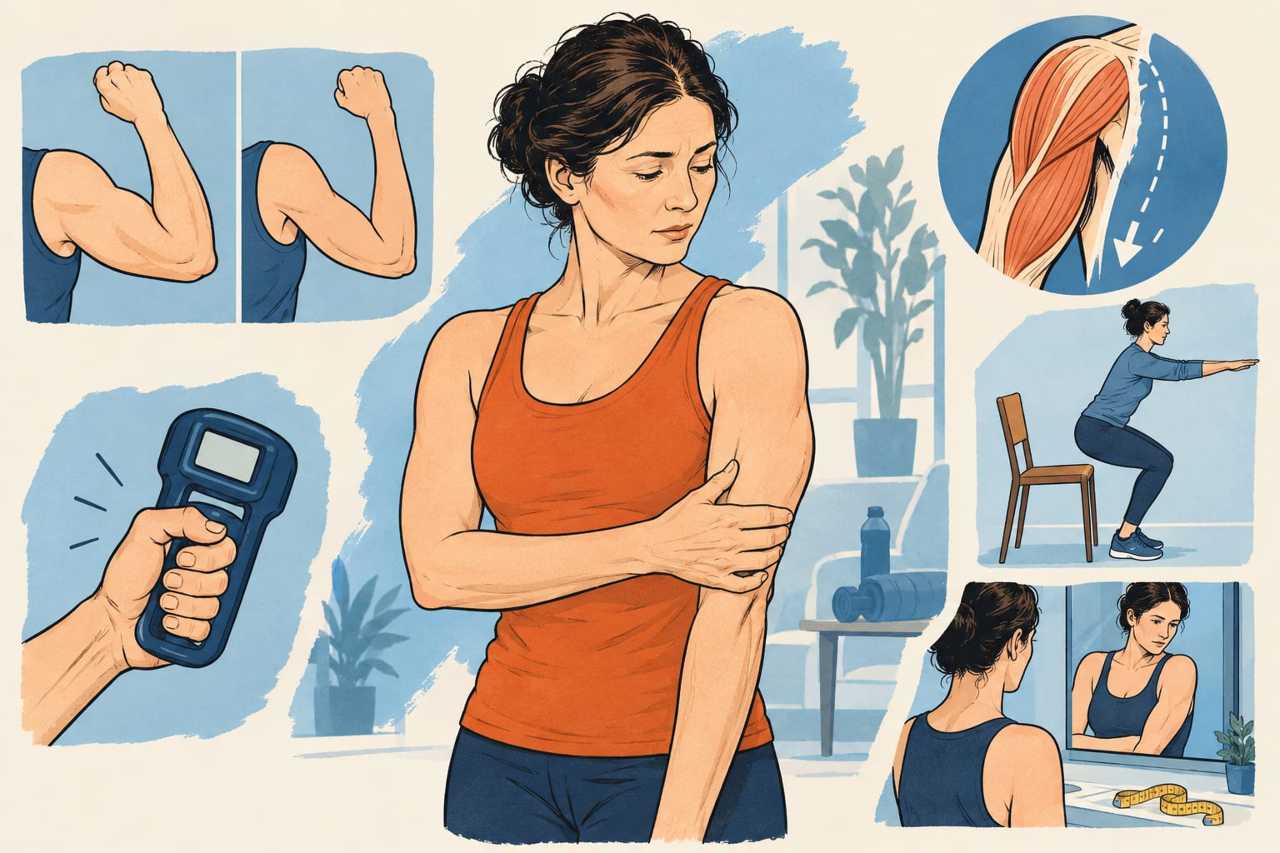
Hospitals use a handful of tools: the Short Physical Performance Battery, which checks balance, walking speed, and your ability to rise from a chair repeatedly. There's also DEXA scanning (the same machine used for bone density, just a different scan mode), BIA machines that measure muscle using a mild electrical current, grip strength tests with a dynamometer, and even calf circumference — since the calf gives a truer read on muscle mass than, say, the thigh, especially if you're carrying extra weight elsewhere.
Rough numbers to know: a calf circumference under 34cm for men or 33cm for women is a flag. A walking pace under 1.2 meters per second (for ages 50-64) or under 1 meter per second (65+) suggests higher risk.
Dr Jeremy Teng of Alexandra Hospital says Asian guidelines now recommend screening from age 50 onward, since muscle mass starts declining faster after that point. Dr Tay Yu Ling from Singapore General Hospital adds that anyone 65 and older with chronic illness, falls, or trouble carrying something as light as 4.5kg should get checked.
The good news: it's not a one-way street
Here's what I liked hearing. Dr Koh confirmed that resistance training and enough protein can improve strength, mobility, and function — even once sarcopenia has set in. It may not fully rebuild what's lost, but it makes your body more resilient, especially during illness or recovery from surgery.
Dr Siew put it well: we check blood pressure before hypertension hits and bone density before a fracture happens. Why not treat muscle the same way?
I'm nearly 70, still hauling my own bags through train stations and up hostel stairs, and that's exactly the point. Muscle isn't something you accept losing. It's something you can keep testing, training, and building — at any age you happen to be.
So maybe the real question isn't whether you're losing muscle without knowing it.
It's what you're going to do about it once you do.
Source: CNA Lifestyle
Read our previous article: It's Never Too Late to Change Your Diet — Even at 85