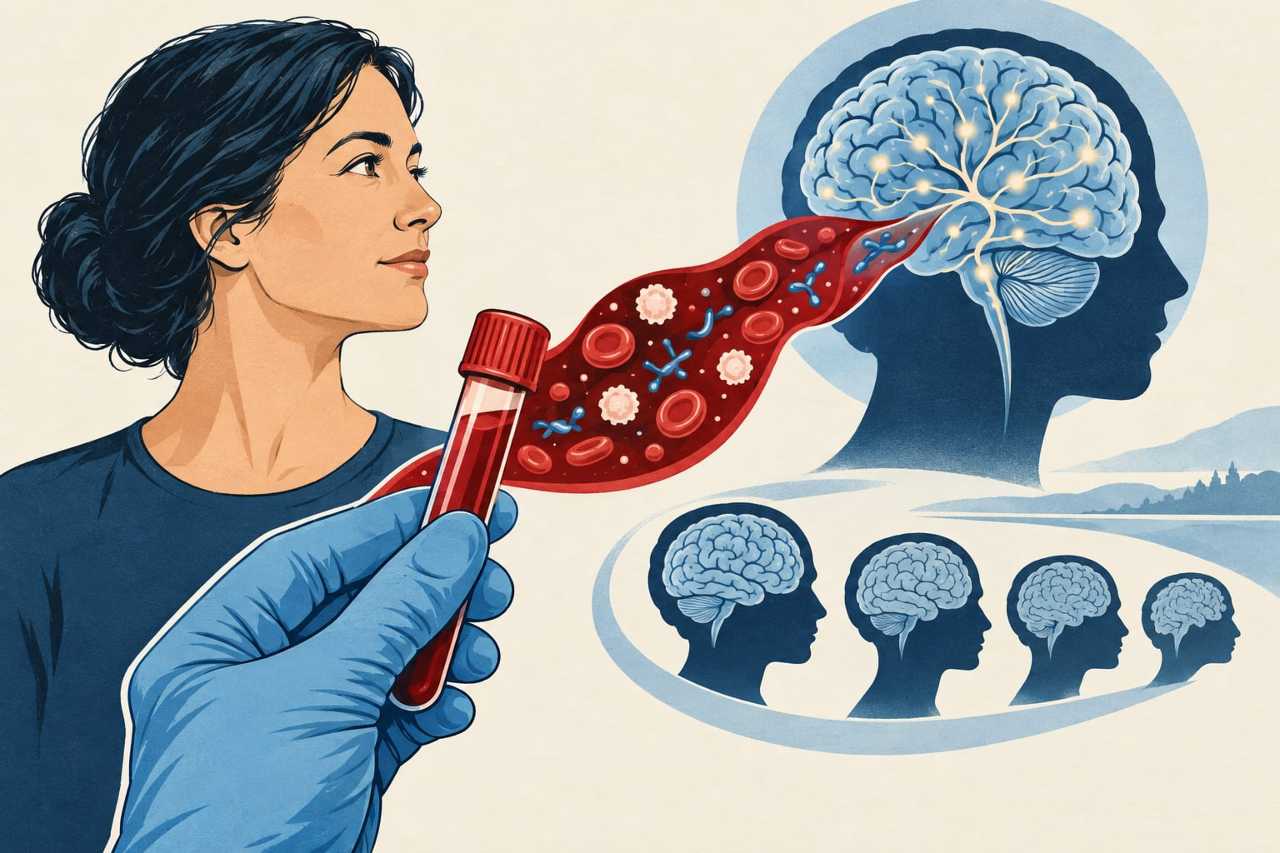
Here's a question I hadn't thought to ask before: can a blood test tell you something about your brain's future before you've noticed a single symptom?
Turns out, maybe.
A team of researchers just published a study in Nature Medicine that followed women through menopause and found something worth paying attention to. As women move through perimenopause into postmenopause, their blood chemistry shifts in specific, measurable ways. And some of those shifts line up with long-term dementia risk.
That's not a small claim. So let's dig into what they actually found.
The study was led by Madeline Wood Alexander at Sunnybrook Research Institute in Canada, along with Rowan Saloner and Kaitlin Casaletto at UC San Francisco. They had help from teams at UC Santa Barbara, Stanford, the University of Toronto, and several other institutions. That's a lot of smart people looking at the same question from different angles, which is usually a good sign in science.
They started by screening thousands of circulating proteins in blood samples from premenopausal, perimenopausal, and postmenopausal women enrolled in UC Santa Barbara's Healthy Aging Study. What they found was sixteen specific molecules that shift as women move through menopause—proteins tied to inflammation, to how neurons function, and some already known to play a role in Alzheimer's disease.
Emily Jacobs, a professor at UC Santa Barbara who worked on the study, put it simply: menopause isn't just a reproductive event. It's a whole-body transition. And apparently it leaves fingerprints in your blood that researchers can now actually read.
Here's where it gets more convincing. The team didn't stop at one study group. They checked their findings against more than 2,800 women in the UK Biobank database—a much larger, independent group. The pattern held. Menopause lines up with distinct signs of accelerated biological aging, and not just in the brain, but across multiple organ systems.
Then they went further and looked at nearly 12,000 older women across four separate long-term studies. Women with higher levels of these risk-associated proteins tended to have worse cognitive outcomes over time. In the largest group, that same protein signature was tied to a modestly higher risk of developing clinical Alzheimer's dementia—tracked over sixteen years.
Sixteen years. That's a long runway to watch something unfold.
Now, before anyone panics—Kaitlin Casaletto was careful to point out that this isn't proof menopause causes Alzheimer's. Most women never develop dementia. The researchers are describing a signal, not a sentence. What they're really saying is that midlife seems to be a window—a period when the brain's long-term resilience or vulnerability gets shaped. And menopause might be a uniquely useful marker for identifying who's heading in which direction.
That's the part that grabs me. We spend so much energy treating aging like something that just happens to us. But what if there's a stretch in midlife where the trajectory is still bendable? Where paying attention early actually changes the outcome later?
The researchers want to build something practical out of this—a standardized blood test that could flag dementia risk in midlife, the same way a cholesterol panel flags heart risk today. Picture that: a simple blood draw during a regular checkup, decades before any cognitive symptoms show up, giving you a heads-up and a chance to act.
To get there, UC Santa Barbara and its collaborators have launched something called the Longitudinal Menopause Project, which is actively recruiting to track women through this transition over time. That's the slow, patient work real science requires—nobody gets instant answers here.
Jacobs made a point worth repeating: women spend roughly a third of their lives after menopause, and we still know surprisingly little about how that transition connects to brain health decades down the road. This study doesn't close that gap. But it hands researchers a foothold—something concrete to chase.
I've spent years believing age isn't something to fight, it's something to understand. Findings like this are exactly why. The more we learn about what's actually happening inside our bodies at midlife, the more power we have to shape what comes next—not by panicking about the years ahead, but by paying attention now.
What happens if you actually knew your risk early? What would you do differently?
That's the kind of question worth staying curious about.
Source: Bioengineer.org
Our last article on this: Three Foods, One Doctor, and the Question That Keeps Me Hooked: Can Longevity Really Be That Simple?