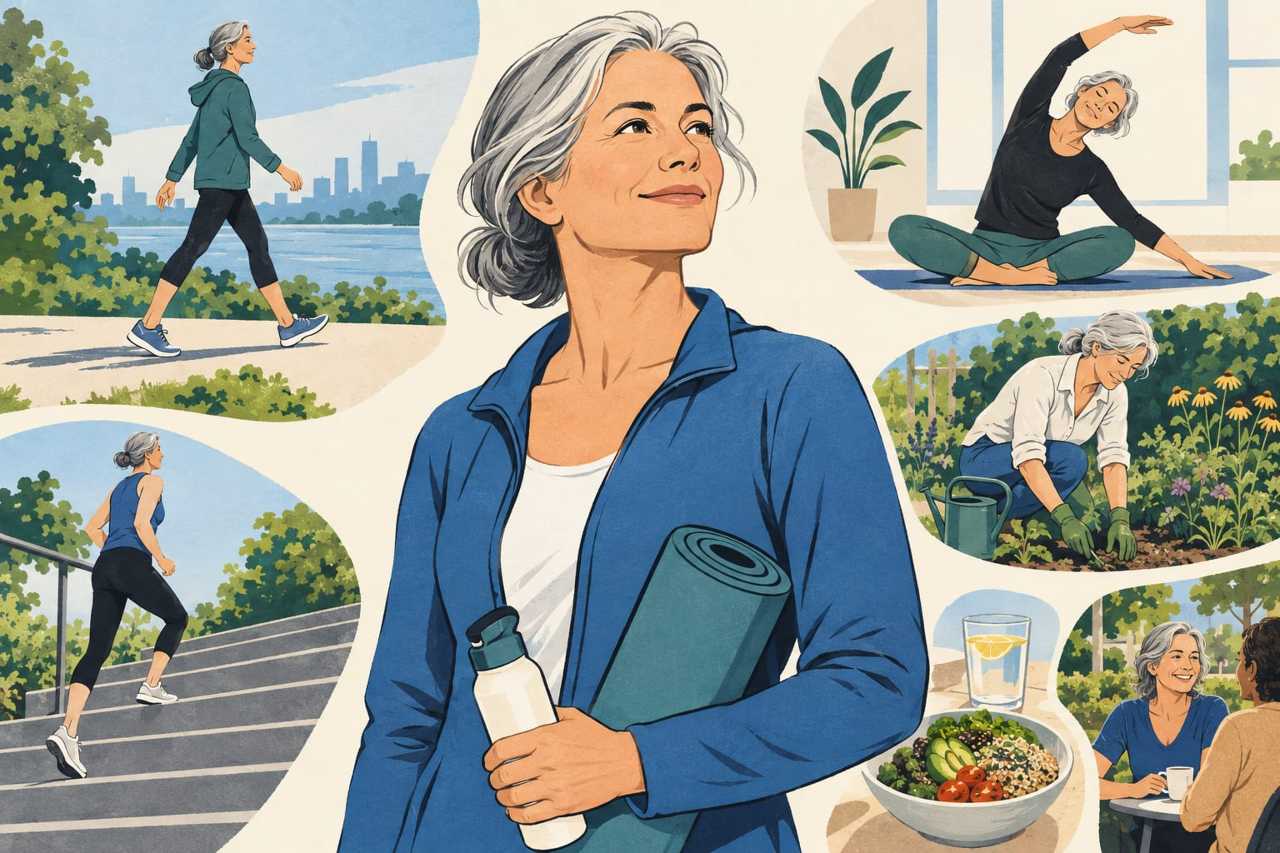
I'll be honest. I've never been a gym rat.
I walk a lot, I hike when the trail looks interesting, and I'll climb a hill just to see what's on the other side. But structured exercise? Not really my thing. So when I came across research suggesting the "official" workout target might be way more than most of us actually need, I got curious.
The World Health Organization and U.S. guidelines say adults should get 150 minutes a week of moderate activity, like brisk walking, or 75 minutes of something vigorous, like running or swimming laps. Add in strength training twice a week and you've hit the gold standard.
Here's the problem. Fewer than half of Americans actually do that. So researchers started asking a different question: what's the least amount of movement that still moves the needle on your health?
The Five-Minute Walk That Changes Your Blood Sugar
Keith Diaz studies sedentary behavior at Columbia University. When I read that he was walking on a treadmill at two miles an hour while being interviewed for this story, I had to laugh. That's basically a stroll. But that's his whole point: movement doesn't need to be intense to matter.
In a small 2023 trial, Diaz had 11 middle-aged and older adults sit for eight hours with different walking-break schedules. Walking just five minutes every half hour cut blood sugar spikes after meals by more than 50 percent, compared to sitting the whole time. Even one minute of walking every hour lowered blood pressure.
One minute. That's shorter than it takes to read this paragraph.
Diaz says we evolved to move throughout the day, not sit for eight hours and then "make up for it" with a workout. Makes sense to me. I've noticed on travel days when I'm stuck on a plane or in a car for hours, I feel noticeably better after even a short walk through an airport terminal or around a parking lot at a rest stop.
Something Beats Nothing, Every Time
I-Min Lee, an epidemiologist at Harvard Medical School and Brigham and Women's Hospital, co-authored a 2015 analysis of more than 660,000 people. The people who did some activity, even less than the recommended minimum, had a 20 percent lower risk of death compared to people who did nothing at all.
Lee calls herself someone who never did much sport either, which I appreciate. Her advice: if you're at a very sedentary point in life, doing any amount of activity helps. You don't need to go from zero to marathon training.
Strength training follows a similar pattern. A 2022 review found just 30 to 60 minutes a week of lifting weights, doing push-ups, or squats was linked to up to a 20 percent lower risk of death from any cause. Interestingly, pushing past an hour didn't add much extra benefit.
Weekend Warriors Get a Pass Too
Here's one that surprised me. You know how people joke about cramming all their exercise into Saturday and Sunday? Turns out that's not as bad an idea as it sounds.
A study following people for decades found "weekend warriors" had a 30 percent lower risk of death from all causes, compared to inactive people. Regularly active people had a 35 percent lower risk, so spreading it out is still better. But bunching your activity into one or two sessions a week still counts for something real.
Emmanuel Stamatakis, a physical activity researcher at Monash University in Australia, points out that benefits keep climbing up to about 300 minutes of moderate activity a week. So the bare minimum is a starting line, not a finish line.
Why This Matters If You're Planning on Sticking Around
I'm closing in on 70, and I've learned something traveling full-time since 2017: the body that keeps moving is the body that keeps going places. I'm not chasing a gym membership. I'm chasing trailheads, markets, hills, and whatever's around the next corner.
Researchers estimate that if middle-aged and older Americans simply added 10 minutes a day of moderate activity, roughly 111,000 deaths a year could be prevented. Ten minutes. That's shorter than most coffee breaks.
So what actually counts? Lee says it's whatever you'll keep doing. Ballroom dancing counts. Walking the dog counts. Gardening counts.
What happens if you stop asking "how much exercise do I need" and start asking "what movement do I actually enjoy"? That might be the real question worth chasing.
Source: Scientific American
See also our earlier piece: The One Nutrient Your Body Needs Most, Decade by Decade