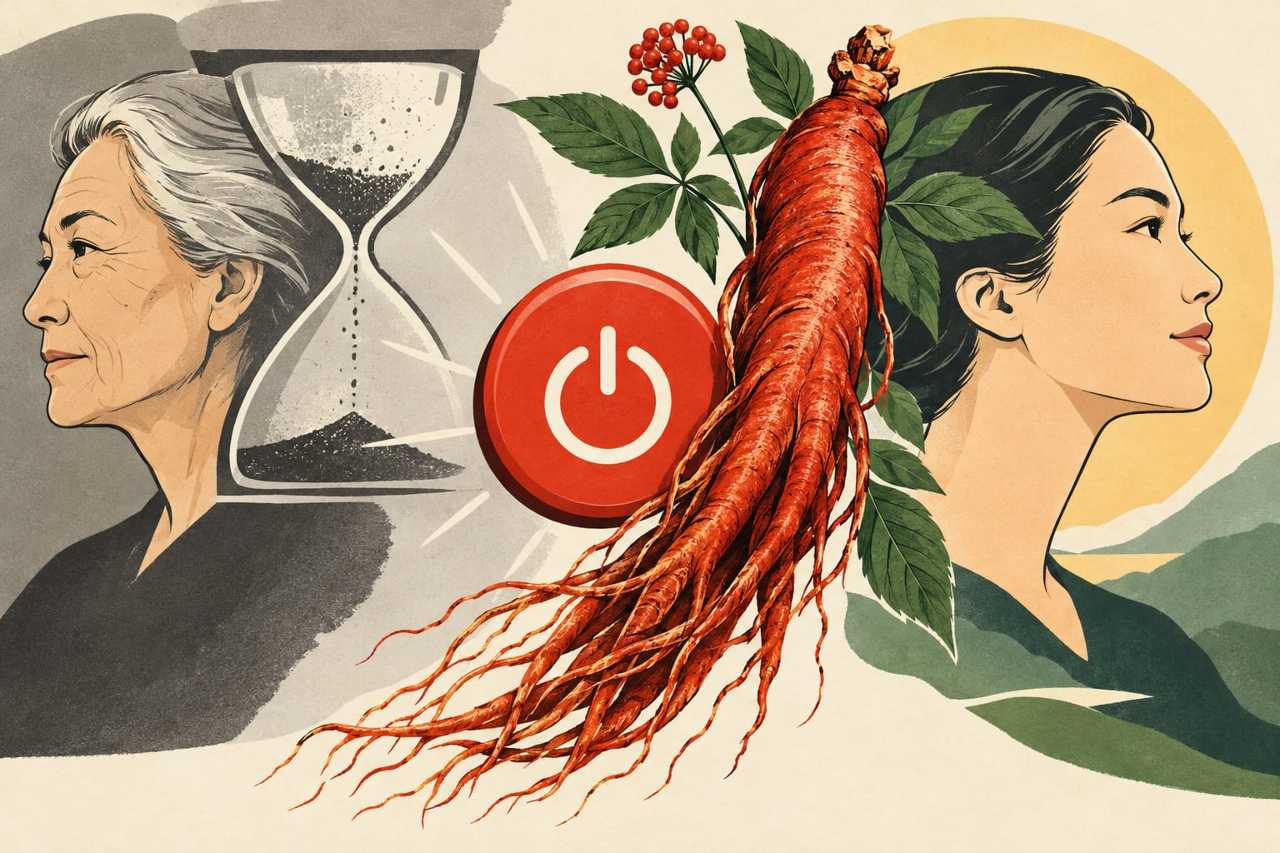
What if the secret to feeling sharper, sleeping better, and keeping your muscles strong into your 70s and 80s was sitting in a root that's been used for thousands of years?
That's the question scientists are chasing right now with red ginseng. And the early answers are hard to ignore.
This week on Jeju Island in South Korea, the Korean Society of Ginseng opened its 14th International Symposium on Ginseng, a four-day gathering of researchers from South Korea, China, and Switzerland. They didn't come to talk about folk remedies. They came with clinical data.
Here's what caught my attention. A team led by Dr. Hong-Sheng Tan at Shanghai Jiao Tong University School of Medicine ran the largest placebo-controlled study ever done on red ginseng. 900 adults, aged 40 to 75, all dealing with chronic fatigue and less-than-great health. Half took 3 grams of red ginseng daily for 12 weeks. The rest got a placebo.
The red ginseng group showed a significant drop in malondialdehyde, which is a fancy way of measuring oxidative stress, basically the cellular wear and tear that drives aging. The effect was strongest in people aged 40 to 60.
But the part that really matters to anyone who's ever struggled to feel rested? Sleep. Using wearable devices on 512 participants, Tan's team found the red ginseng group got 12.5 more minutes of deep sleep and 35.9 more minutes of total sleep compared to the placebo group. That's not a rounding error. That's the difference between waking up foggy and waking up ready to move.
Quality of life scores climbed too, with the biggest gains showing up in physical function and vitality. As Tan put it, this offers a non-pharmacological way to support aging bodies. No prescription required.
Then there's the brain. Researchers at Konyang University College of Medicine, led by Dr. Moon Minho and Dr. Nam Yunkwon, looked at a compound in red ginseng called KRGP. Using mouse models bred to develop Alzheimer's-like disease, they found KRGP reduced the buildup of amyloid-beta plaques and tau tangles, two of the main culprits behind cognitive decline. It also helped restore damaged signaling between neurons and encouraged new cell growth in the hippocampus, the part of the brain responsible for memory.
Over in Switzerland, Dr. Johan Auwerx at the École Polytechnique Fédérale de Lausanne tackled a different angle: what red ginseng does for metabolism. His team found it reduced body fat and liver scarring in mice fed a Western-style diet, while also normalizing blood sugar and insulin sensitivity. In plain terms, it helped protect the liver from the kind of damage that comes from eating the way most of us do.
And then there's muscle. Dr. Park Sang-Min at Chungnam National University studied sarcopenia, the muscle loss that creeps up as we age and quietly steals strength and independence. His team found that red ginseng and one of its active compounds, ginsenoside Rb2, eased the loss of muscle strength and motor function in aging mice. More interesting, the effect wasn't just local. It worked through a network connecting muscle, brain chemistry, and liver metabolism all at once.
So why does any of this matter to you?
I'm closing in on 70, and I've spent the last several years traveling full-time, which means my body has to keep up with a life that doesn't slow down just because a number on a calendar goes up. Sarcopenia, brain fog, bad sleep, these aren't abstract medical terms to me. They're the difference between hiking a trail in Portugal or sitting it out.
This research doesn't hand anyone a miracle cure. But it does suggest something worth paying attention to: a natural compound studied across three continents, showing measurable effects on sleep, brain health, metabolism, and muscle strength all at once.
Healthspan, not just lifespan. That's the real goal. Living longer only matters if you're still strong enough, sharp enough, and rested enough to actually use that time.
I'll be curious to see what the rest of this symposium turns up. In the meantime, I might just start asking my doctor what she thinks about red ginseng.
Source: KED Global
Before this, we covered: Your Gut Might Be the Real Secret to Aging Well