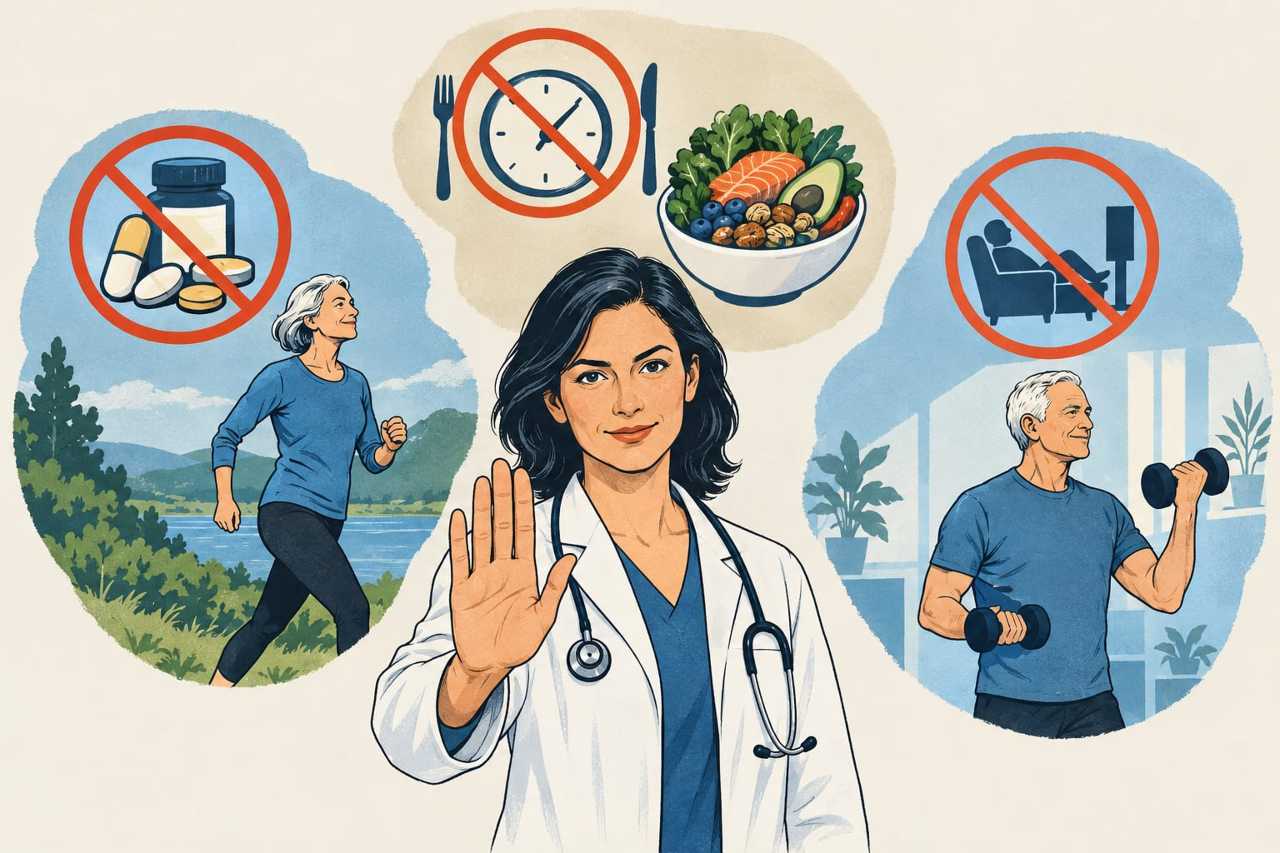
There's a headline from CNBC that stopped me mid-scroll: doctors say the most important factors in a long life "don't cost anything." No supplements. No $300 cold plunge tubs. No biohacking gadgets strapped to your wrist at 2 a.m.
That's it. That's the whole punch line. And it's worth sitting with for a minute.
I've spent the last eight years living out of a backpack, moving between countries, meeting people in their 80s and 90s who are still climbing hills, still running shops, still showing up to dance on Saturday nights. None of them mentioned a supplement stack. Not once. So when I see doctors pushing back on longevity myths, I lean in. Because I think they're onto something I've been noticing anecdotally for years.
Here's the thing about the longevity industry: it's enormous, and it's built on the idea that living longer requires buying something. A $2,000 red-light panel. A $900 wearable that tracks your sleep down to the minute. A subscription supplement box that shows up every month whether you need it or not.
And look, I'm not against any of that stuff on principle. If it works for you, great. But the doctors behind this story are making a different point entirely — that the factors proven to matter most aren't for sale. They're free. They're things anyone, anywhere, at any income level, can start doing today.
So what are they?
The article doesn't spell out all three myths in detail, but the core message doctors keep hammering is consistent across the research I've come across in my own reading: it's not the expensive interventions that move the needle on how long — and how well — you live. It's the basics. Movement. Sleep. Connection to other people. Purpose. A reason to get out of bed that has nothing to do with obligation and everything to do with wanting to.
Why does that get overlooked? I think it's because free things don't sell anything. Nobody makes money convincing you to take a 30-minute walk or call your sister. There's no margin in telling someone their best longevity hack is a decent night's sleep and a few close friends. So the loud, expensive stuff gets the marketing budget, and the quiet, free stuff gets buried.
I've tested this myself, in a completely unscientific way. When I'm in a new city — say, wandering the backstreets of Lisbon or hiking somewhere in Northern Thailand — I'm moving all day without trying to "exercise." I'm talking to strangers because I have to figure out the bus system. I'm curious about everything, because everything is new. And I sleep like a rock, every single night. No app told me to do any of it.
Compare that to stretches back home where I'm sitting at a desk, scrolling instead of talking to a neighbor, telling myself I'll sleep better "tomorrow." Same body, same age, wildly different outcome in how I feel.
That's really the "so what" here. If the doctors are right — and this isn't the first time I've seen this argument, it just keeps getting confirmed — then you don't need a bigger budget to live longer. You need to actually do the boring stuff consistently. Move your body. Protect your sleep. Keep real relationships instead of just digital ones. Find something that gives your days a point.
I'm closing in on 70, and if anything, that's made me more convinced, not less. I didn't get here by optimizing my blood panels. I got here by staying curious, staying in motion, and refusing to believe that a slower, smaller life was the price of getting older.
The myths will keep selling. Expensive always sounds more credible than free — that's just human nature. But maybe the real experiment worth running isn't buying the next gadget. It's asking yourself a simpler question: when's the last time you walked somewhere just because you wanted to see what was there?
Try that this week. See what happens. It doesn't cost a thing.
Source: CNBC
Catch up on our earlier post: Your Body Keeps Score, and It's Counting in Years