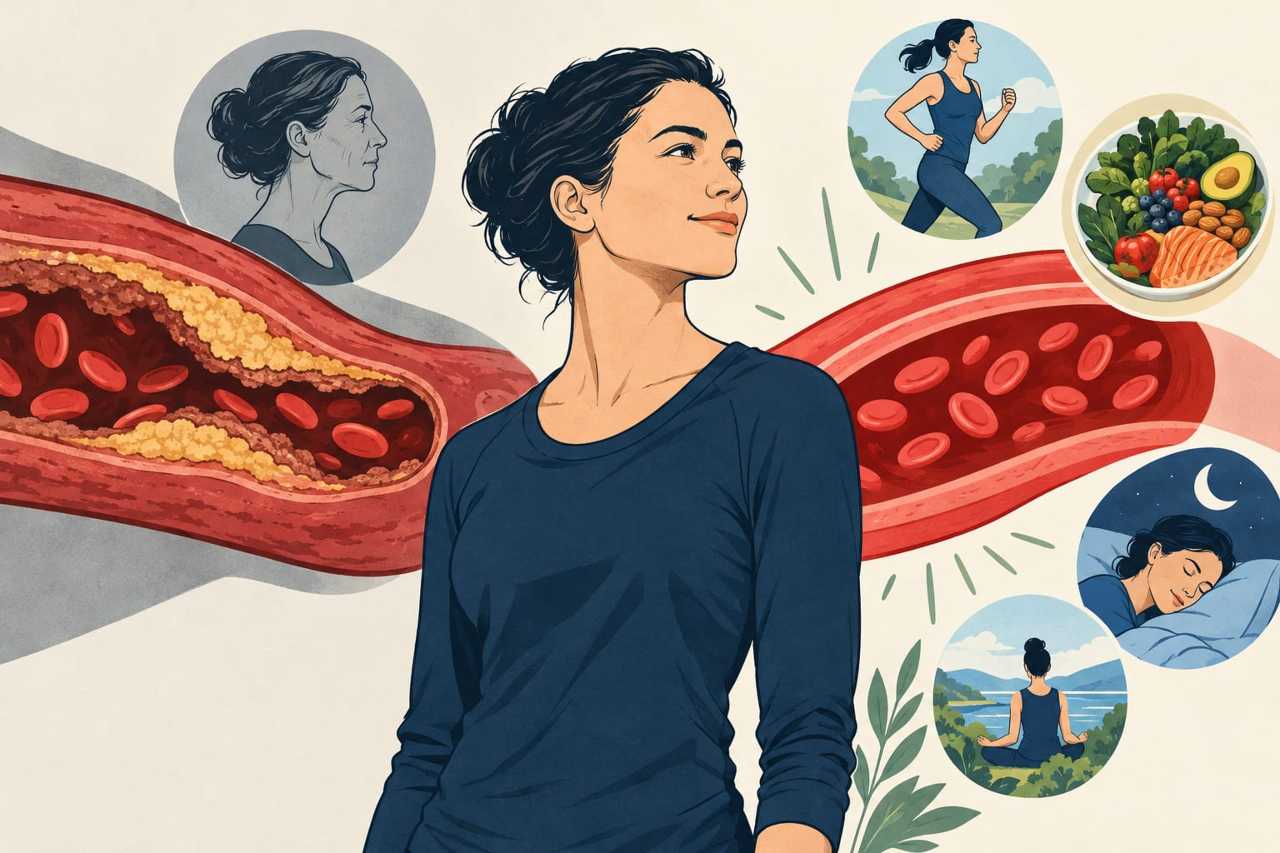
I didn't know my arteries started showing wear before I even hit my thirties. Did you? Turns out blood vessels are often the first part of the body to clock in overtime, sometimes a full decade before you notice anything's off. That's the starting point for a new study that caught my attention, and it's worth digging into.
A company called NOVOS makes a daily supplement called NOVOS Core, built around the idea that aging isn't one single switch — it's a bunch of connected processes happening at once. Christian Heiss, a professor of cardiovascular medicine at the University of Surrey, led a randomized, double-blind, placebo-controlled trial to find out if that idea actually holds up in real people. Not mice. Not cells in a petri dish. People.
The trial's called STAMINA — Effects of a Supplement to Target Ageing Mechanisms on Vascular Function — and it ran out of the University of Surrey with the Royal Surrey NHS Foundation Trust, with results published in the European Heart Journal Open.
Here's what they did. Sixty-one healthy, non-smoking adults, all 40 or older, were split into two groups. Thirty-three got NOVOS Core, a 12-ingredient formula that includes things like vitamin C, magnesium malate, fisetin, pterostilbene, and lithium aspartate. The other 28 got a placebo. Six months later, the researchers measured how well their blood vessels were functioning.
The results surprised even the people who ran the study. Blood vessel function — measured through something called flow-mediated dilation, basically how well an artery widens when blood flow increases — jumped 47% from baseline in the supplement group, with a 2.9% improvement over placebo. Researchers called that clinically meaningful. And get this: some of that improvement showed up within an hour of the very first dose.
Arterial flexibility improved too. Stiff arteries are bad news — they're linked to higher cardiovascular risk as we age. The study measured this with pulse wave velocity, and the gap between groups worked out to 1.18 meters per second. Since arteries typically stiffen by about 1.0 meter per second per decade, that difference translates into a meaningful chunk of "vascular age" turned back.
Systolic blood pressure dropped 6.1 mmHg more in the supplement group than in the placebo group. Cholesterol and triglycerides, though, didn't budge in either direction.
I actually like that last part. Diogo Barardo, Director of R&D at NOVOS and a co-author on the paper, said it wasn't surprising that cholesterol stayed flat — and honestly, it tells you something. If three separate markers improved while cholesterol didn't move, that suggests the change is coming from the blood vessels themselves, not from some broad, vague effect. That's the kind of specific, traceable result that makes a study worth paying attention to instead of just another supplement claiming to "support longevity."
NOVOS founder and CEO Chris Mirabile put it plainly: the company started with blood vessels because they feed every organ in the body and they age early. He's also been upfront that this is "early human evidence" — a six-month trial measuring cardiovascular markers, not a claim about reversing biological age itself. "Direct measures of biological aging come next," he said.
What struck me most, though, was Mirabile calling out his own industry. He said the longevity supplement market is growing faster than the science behind it, and he laid out a standard he thinks every company should be held to: randomized, placebo-controlled trials on the whole formula, run by independent researchers, published after peer review, measuring actual organ function instead of indirect markers. Then he said something I don't hear often from a CEO — he invited people to hold his own company to that same bar.
That's refreshing. I've spent years asking "what happens if I actually test this instead of just trusting the label?" — whether it's a supplement, a route across a border, or a plan for where I'll be living next year. Curiosity only works if you're willing to check your own assumptions too.
So here's the real question for you: are you waiting for your thirties-era arteries to announce themselves with a problem, or are you curious enough to start asking what's actually measurable, right now, about your own health? The data's starting to show up. What you do with it is still yours to decide.
Source: NutraIngredients.com
Read our previous article: Over 65 and Thinking About a GLP-1? Here's What One Geriatrician Wants You to Know